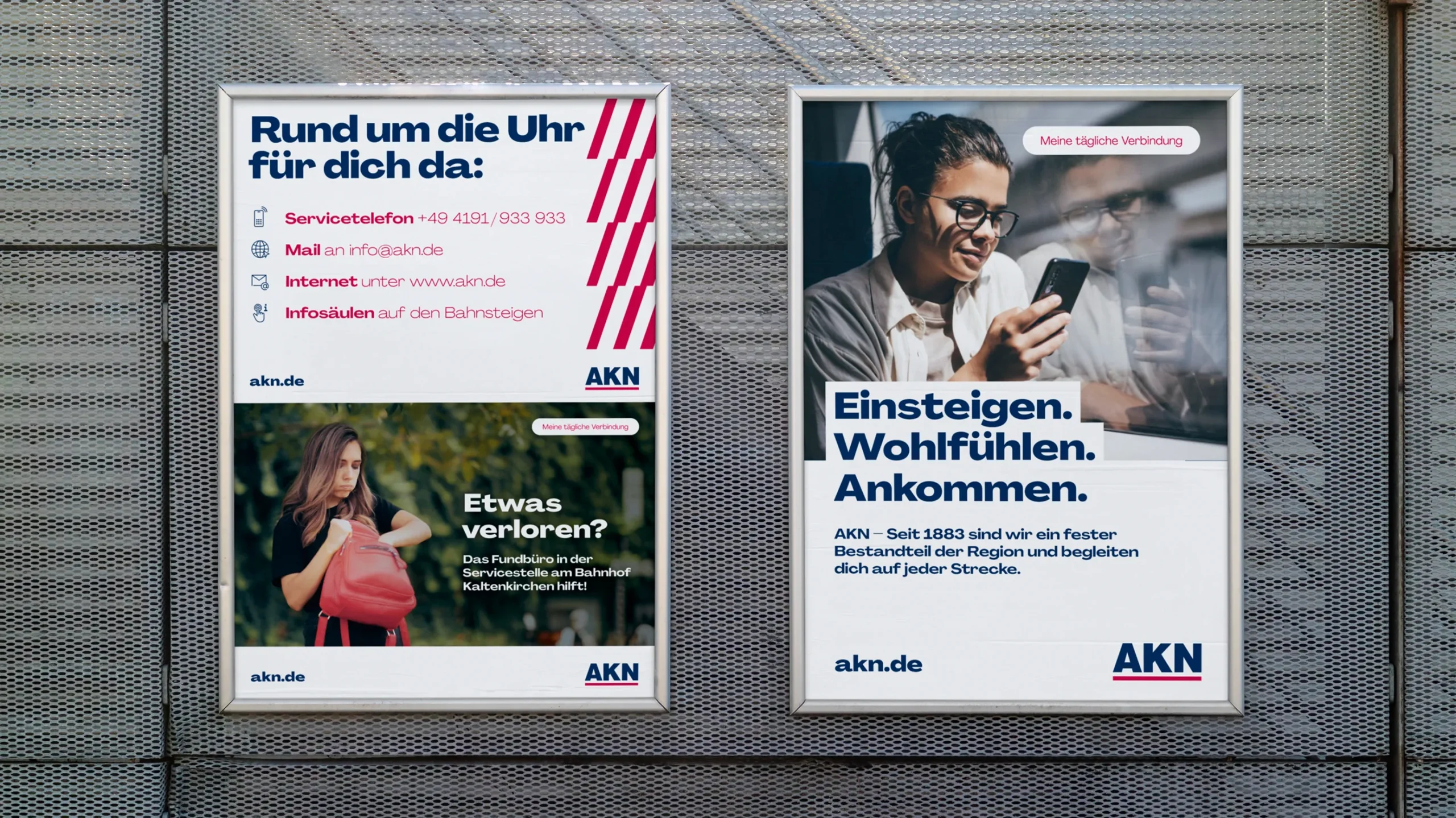
AKN Railway: Why a Clear Strategy Matters More Than Countless Design Options
Our collaboration with AKN Railway demonstrates just how important strategic brand work is.
Since 1883, this northern German transport company has connected people, towns and regions. Its brand stands for regional mobility, reliability and a long-established bond with people in the north.
The task was to modernize the brand’s appearance without abandoning that identity.
A modern corporate design must do more than look convincing. It must provide guidance, connect different applications and support a company’s everyday communications.
For AKN, this meant developing a shared design foundation for the logo, website, timetables, icons and campaigns.
The decisive question, therefore, was not how many new design ideas were possible.
It was which changes actually made sense.
Rather than replacing the existing identity entirely, we deliberately used the established logo and color palette as our starting point.
Building on this, we created a consistent corporate design that respects AKN’s history while meeting the requirements of modern mobility communications.
Clear typographic structures support readability. A systematic icon design makes navigation easier. And a consistent visual language connects digital and physical touchpoints.
Campaign communications also show why strategy and design belong together.
With the “Folge dem Lokruf!” (“Answer the Call of the Locomotive!”) campaign, communication with potential new train drivers became clear, direct, and accessible.
The example illustrates that successful brand development does not arise from creative variety alone. It requires decisions about what to preserve, what needs to change, and how both can work together meaningfully.
AI can help with this. It can suggest design options, create variations, and speed up processes.
But whether an existing logo still fits the brand, which visual elements help passengers find their way, and how different communication tasks can be brought together in one system must be assessed in the company’s specific context.
The quality of a brand strategy is not measured by how many possibilities it opens up, but by which decisions it can justify.
That is precisely the difference between producing a new visual identity and strategically developing a brand further.
What Hi-TiDE™ Does Differently as a Branding Agency
At Hi-TiDE™, we don’t see branding as producing as many design solutions as possible.
Our work begins with the company itself.
Its history, its people, its culture, and its business goals. We explore what already defines a brand, where its strengths lie, and which changes are needed to keep it relevant in the future.
This perspective matters most in rebranding projects, business succession, and for established medium-sized brands.
In these situations, the aim is rarely to invent something entirely new.
It is about identifying and preserving what matters and translating it into a contemporary brand identity.
To achieve this, we combine strategic analysis with personal dialogue, design experience and a clear understanding of business realities.
We question obvious solutions. We look for the qualities that truly set a company apart. And from these, we develop brand identities that not only work visually but also have a sound strategic foundation.
For us, AI is not an adversary.
It is a tool.
A powerful tool that can support research, analysis, idea generation, and creative processes.
But a tool cannot replace a point of view. Nor can it replace the ambition to develop a solution that fits a specific company rather than merely following current design trends.
Why Human Experience Becomes More Valuable Because of AI
As content, images, and concepts become available ever more quickly, the value of creative work is changing too.
Production alone is losing some of its former exclusivity.
The skills that come before production are becoming more important: understanding connections, framing problems correctly, asking relevant questions, and justifying decisions.
For companies, this represents a shift.
The crucial question in the future will be less: Who can develop a new visual identity for us as quickly as possible?
And more: Who understands our company well enough to recognize what kind of brand we really need?
An experienced branding agency therefore delivers more than results. It provides direction.
It helps distinguish short-term trends from long-term relevance. It reveals contradictions and translates complex business realities into a clear brand identity.
The quality of brand work therefore does not depend solely on the tools used.
It depends on how well people ask the right questions, challenge the answers, and derive sound decisions from them.
How Companies Can Use AI Effectively for Branding
AI and branding are not mutually exclusive.
On the contrary: used correctly, artificial intelligence can enrich strategic and creative processes.
For example, it can help structure market information, develop initial communication approaches, analyze language patterns, or visualize different ideas.
Its use becomes problematic when teams adopt generated results without scrutiny as the strategic foundation of a brand.
Before using AI, companies should therefore have clarity on three questions:
- Identity: What does our company truly stand for?
- Differentiation: What credibly sets us apart from competitors?
- Responsibility: Who evaluates, decides, and reviews the results?
The clearer the answers to these questions, the more effectively we can use AI.
A good brand strategy does not make artificial intelligence redundant. It gives it direction.
Conclusion: The Future Belongs Not to the Loudest Brands, but to the Clearest
Artificial intelligence will continue to transform brand development. Many processes will become faster, more accessible, and more efficient.
That is no reason to cling to established ways of working.
But it is a reason to think more carefully about where branding’s real value lies.
Not in the number of ideas. Not in the speed of design. And not in the ability to produce new content at any time.
But in a credible identity. In positioning that provides direction. And in design that makes visible what truly sets a company apart.
At Hi-TiDE™, we therefore combine strategic experience, human understanding, design excellence, and technology used with purpose.
Not against AI. Against interchangeability.
A brand does not have to be everything. But it should know who it is.
Frequently Asked Questions About AI and Branding
What risks arise from using AI in branding without a clear brand strategy?
When companies develop their brand identity exclusively with AI, they risk adopting positioning that sounds professional but is not sufficiently rooted in their actual corporate culture. Without strategic review, generic brand promises, unsuitable design solutions, and contradictions between communication and business reality can arise.
How can companies tell whether AI is making their branding generic?
A warning sign is when a company’s brand communication is barely distinguishable from its competitors’. Repeated stock phrases, similar visual worlds, and generic brand promises can indicate this. A systematic brand comparison helps determine whether the positioning communicates recognizable differences.
What role does a branding agency play when AI is used?
A branding agency provides strategic assessment and creative direction. It analyses the company’s identity, questions the results generated, and develops consistent brand positioning. AI can speed up individual tasks, while the agency ensures design and communication are grounded in well-reasoned business decisions.